A Dream

When you awaken from a dream and return to your familiar experience of space, time, and identity, it’s easy to differentiate and say, “it was just a dream.”

Here is Zhuangzi’s Butterfly dream:

“Once Zhuang Zhou (Zhuangzi) dreamt that he was a butterfly, a butterfly flitting and fluttering around, happy with himself and doing as he pleased. He didn’t know he was Zhuang Zhou. Suddenly he woke up and there he was, solidly and unmistakably Zhuang Zhou. But he didn’t know if he was Zhuang Zhou who had dreamt he was a butterfly, or a butterfly dreaming he was Zhuang Zhou. Between Zhuang Zhou and a butterfly there must be some distinction! This is called the “transformation of things.” (Zhuangzi, ch. 2; trans. Watson)

Dream and wake are different psychic states. Even though dreams may be vivid and gripping when we are dreaming, they are unreal when reviewed from the wake state. Dreams are not subject to the dependable constraints of space, time, identity, and gravity that we experience in the wake state. So it’s easy, when we awake, to say, “It’s not real, it was just a dream.”

On the other hand, “reality” is clear as daylight because we experience it repeatedly. We believe that it just “is.” That tomorrow when we wake up, we will still be the same person and that the world and other people as we know them will still be very much the same. 

We hold on to this belief tenaciously. Maybe we have a need to. But it is obvious that every person’s reality is not the same. In fact, they may be drastically different. So, is our individual sense of reality simply a psychic state we insist on perpetuating? In psychological terms, this is called a trance. Is our sense of reality a deep trance we enter into and reinforce everyday?

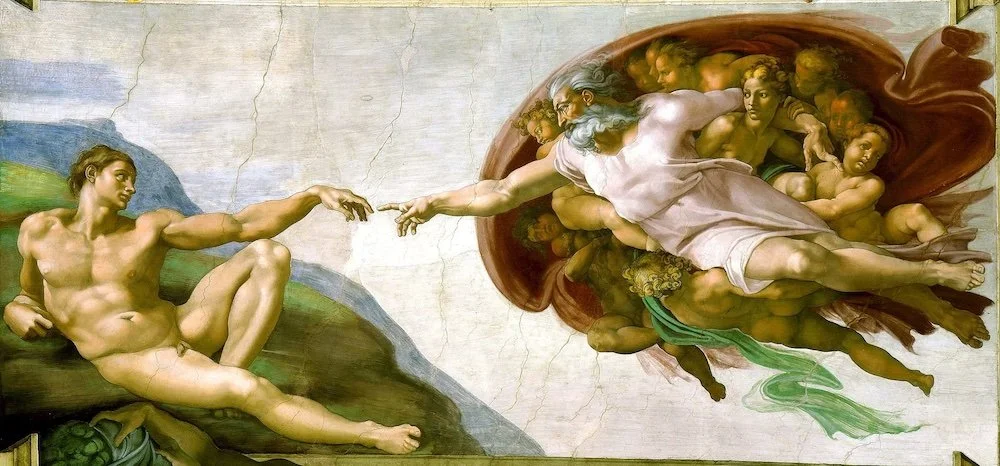
In Jorge Luis Borges’ story “The Circular Ruins,” a man arrives at the ancient ruins to dedicate himself to dreaming another human being into existence. After years of effort, his creation comes to life: a being unaware of his origin. A fire approaches the ruins. The man, his dream fulfilled, walks into it but finds himself unburned. The man now realizes that he himself is the dream of another man. Maybe himself.
The Song & the Dance of Eight Section Brocade Qigong

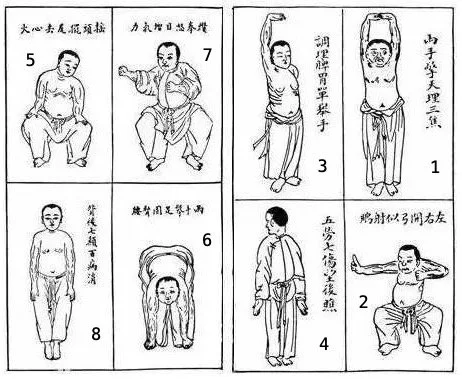
The eight movements of the Ba Duan Jin are famously captured in a song with eight rhyming lines, each succinctly describing the movement and its benefits.

When Song Dynasty writers first talked about Ba Duan Jin (1150’s) they already included verses but they never gave the routine a name. (Read about the evolution and tributaries of the Ba Duan Jin form). It was not until the late Qing Dynasty that a text (1890) presented the movements with illustrations, accompanied by the song, and named them the Ba Duan Jin. One century later, in 1989, another author rewrote the song, changing few words but transposed the sixth and eighth lines and hence the order of the movements and there we have version we practice today.

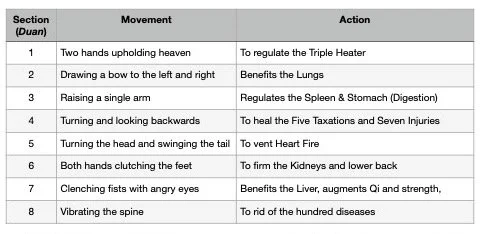
The rhyming lyrics of the song are a great mnemonic device but help little if one doesn’t speak Chinese. Here I will present the original illustrations with a breakdown of the meaning of the lines. These are just snapshots but it’s good to get acquainted with them. Then when you come to class you can let your body learn the movements. Afterwards you can go back to these notes and they will make a lot more sense.

Notice that there are eight different ordered movements addressing all the organs: San Jiao (Triple Heater), Lungs, Spleen, Heart, Kidneys & Liver.

The Action part includes many Chinese medical terms. The organ names are capitalized because they have physiological, psychological and spiritual meanings far beyond their commonly known organic functions. We will talk more about them in class.

The Completeness of Eight Section Brocade Qigong

I like Eight-Section Brocade Qigong because it is complete and balanced. I can get so much done in just a few minutes. Let’s first consider its completeness.
Yes, there are eight movements in Eight-Section Brocade, but the number eight is also a reference to Ba Gua, the eight trigrams which in Chinese numerology means completeness.

So, how is Eight-Section Brocade complete? It activates and balances all body organs and regulates the Three Burners. The Three Burners store the precious substances of Jing (Essence), Qi, and Shen (Spirit). In other words, Eight-Section Brocade benefits not only physical organs, but also strengthens and harmonizes body, mind, and spirit.

The Eight Section Brocade Song has lines that say it heals all imbalances and the hundred diseases. Quite a tall order! So how does it accomplish that? I can offer a simple, physical explanation: virtually each and every movement in Eight-Section Brocade is focused on mobilizing the spine, from the cervical to the coccyx. There is lengthening, flexion, extension, rotation, vibration and combinations thereof. These movements stimulate the central nervous system via the spinal cord and the peripheral nervous system via the spinal nerves. They also regulate the thoracolumbar outflow of the sympathetic and the cranial sacral outflow of the parasympathetic nervous system. Eight-Section Brocade is a physical as well as a neurological workout, with immense benefits. The nervous system is like an electric grid that supplies all body organs and functions. Working through it, Eight-Section Brocade can reach all the targets. It is ‘complete’ in this way.